
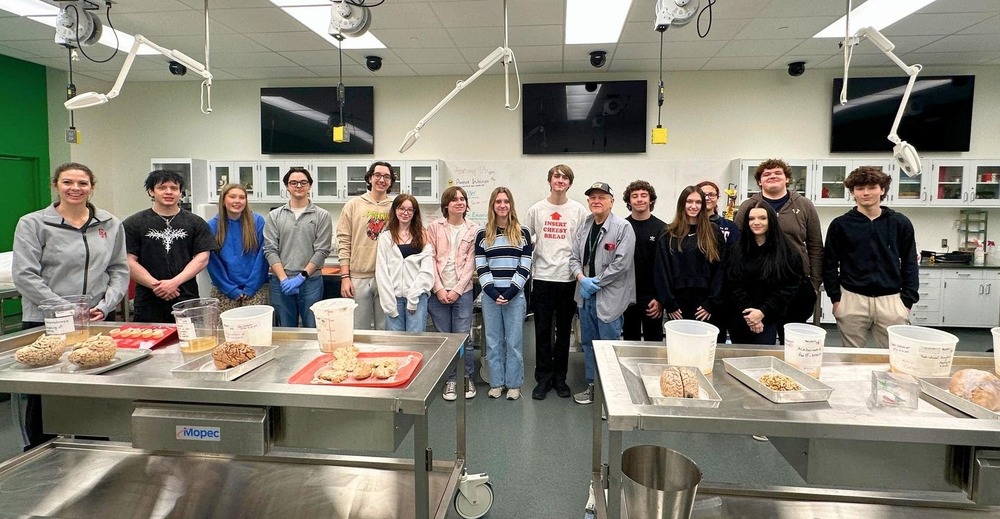
A recent visit to Cleveland State University enabled students in Jordan Wajda’s AP Psychology class to learn firsthand about the brain from a neuroscientist. They examined both human and animal brains, as well as spinal cords and eyes. This hands-on experience provided a deeper understanding of how different parts of the nervous system are structured and how they function.
“One of the most impactful parts of the trip was observing brains affected by various conditions,” said teacher Jordan Wajda. Students saw firsthand the physical effects of a stroke, Alzheimer’s disease, and a brain bleed. Being able to visualize these differences helped students connect classroom learning to real-life examples of how the brain influences behavior and thinking..
"Throughout the experience, students applied key AP Psychology concepts,” noted Wajda. “Topics such as action potentials, axons, dendrites, neurons, and major brain structures were reinforced as students made connections between theory and real brain tissue.”
Students also met with a biomechanist, who discussed research methods and provided a tour of the Human Performance Lab. This portion of the trip offered insight into how scientists study human movement and design experiments. Overall, the field trip provided a valuable opportunity for students to connect classroom learning to real-world applications, careers, and academic pathways.”